
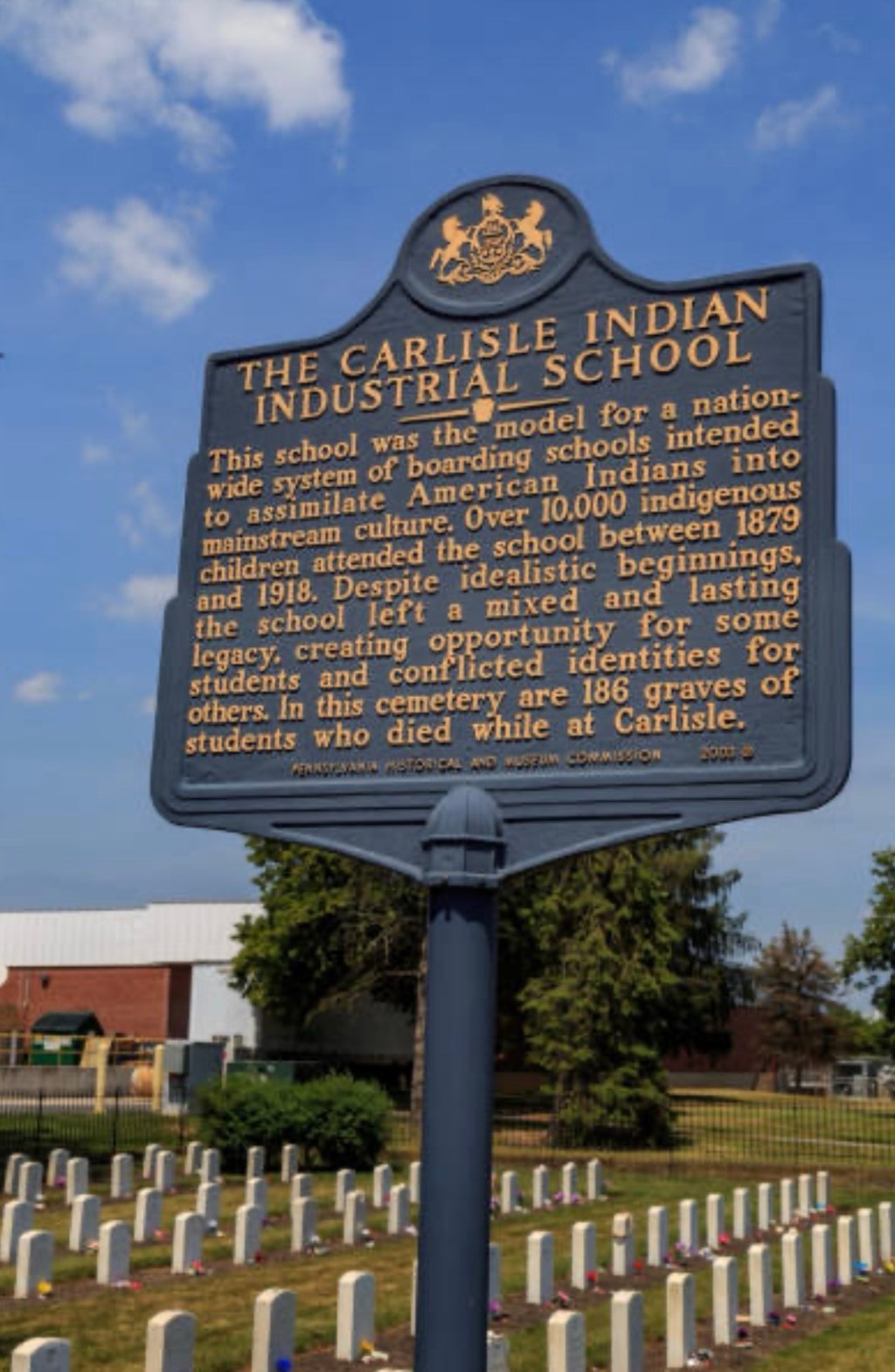
Native American education became an area of interest for the United States government after eradication of Indigenous populations through warfare was considered too costly. Massacres such as that which occurred at Little Bighorn in 1876 cost money, United States soldiers’ lives, and conjured up sympathy for Native American tribes from American reformers. These reformers included Herbert Welsh and Henry Pancoast who created the Indian Rights Association in 1882. This association called for the assimilation of Native American children into what they saw as the civilized society of White America. The means of accomplishing assimilation for the Indian Rights Association was boarding school education. One major off-reservation boarding school was already seen as a successful institution for assimilating Native American children into Euro-American society. This institution was the Carlisle Indian Industrial School in Carlisle, Pennsylvania established in 1879. Richard Henry Pratt, a General in the United States military founded the school after he had success assimilating Native American war captives in 1875 at Fort Marion in Florida. These captives were from the 1874 Red River War and were sentenced to incarceration due to supposed war crimes. Pratt used his position as overseer of the captives to assimilate these prisoners by enforcing White American dress, teaching English, loaning the men out to work for local businesses to earn money, and allowing Episcopalian bishop Henry Whipple to preach to the men. Pratt saw his endeavor as a success and used this blueprint to open Carlisle Indian Industrial School.
Carlisle recruited Native American children from multiple tribes around the country, and the school was run like a military operation. Students dressed in uniforms similar to those worn in the military, and were forced to conduct military drills in the schoolyard. Carlisle became the model for additional boarding schools opened throughout the United States. Welsh and Pancoast used this model to lobby Congress for support of government sponsored off-reservation boarding schools. This lobbying was successful thereby establishing popular and governmental support for these institutions.
The United States government approved opening of additional Indian schools, and plans were laid for the running of the institutions. The main goal of education at boarding schools was to assimilate Native American children into Euro-American culture. However, there were ways of enforcing and obtaining this goal that were considered. Pratt’s example at Carlisle called for children to be removed from their communities to minimize influence of their families and cultures. Carlisle became the model for all other government run boarding schools, therefore the removal of children from their families and communities became common practice. Most Native American families were unwilling to voluntarily send their children to these schools; therefore, children were forced from their families. Juanita Cruz Blue Spruce was sent to the Santa Fe Indian School in 1915. She remembers the day she was removed from her community and home as follows, “I remember it was in October they came to get me. My mother started to cry, ‘Her? She’s just a little girl! You can’t take her.” After children arrived at boarding school, they were forbidden from using their native languages, dress, and names. This was done in an effort to further alienate them from their Indigenous cultures. Once students were stripped of their clothing and hair, they were then introduced to the curriculum of their boarding school. The curriculum utilized taught White American economic trades and gender norms; skills deemed necessary for assimilated Native Americans. Boarding school curriculum also taught Christianity, notably Protestantism and Catholicism, and often forbid traditional Native religious practices. In addition to the curriculum, illnesses ran rampant in boarding schools. Overcrowding, changes in diet, and unsanitary living conditions contributed to the spread of diseases like smallpox, which infected and killed many students. Despite these conditions and the curricula aimed at assimilation, not all boarding school experiences were negative. In former student Paul Buffalo’s interview he expresses gratitude to the Vermilion Lake Indian School for keeping him well fed, teaching him English, and for being able to learn a trade.
While positive experiences did exist, the impacts on students who returned to their communities from boarding schools were largely negative. Time away from their communities caused former boarding school students to feel isolated from their tribes and they were unable to fully integrate themselves in White American society. The impacts of boarding schools are still felt in Native American communities today. Assimilation through Indian boarding schools amounted to genocide. This in addition to memories of generational trauma through mental, physical, and sexual abuses that student were forced to endure causes lasting impacts on Native communities today.
Further Reading:
Adams, David Wallace. Education for Extinction: American Indians and the Boarding School Experience, 1875-1928. (Lawrence, KS: University Press of Kansas), 1995.
The Heard Museum. “Away From Home American Indian Boarding School Stories: Journey and Arrival.” Accessed March 11, 2022. https://heard.org/boardingschool/journey-and-arrival/
Buffalo, Paul. “When Everybody Called Me Gabe-bines, “Forever-Flying-Bird”: Teachings from Paul Buffalo.” Interview by Timothy Roufs. University of Minnesota Duluth, 1967.
 My Dark History
Leave a comment